
Pointedly blaming Congress general secretary Rahul Gandhi for the United Progressive Alliance's government's nod to Foreign Direct Investment in retail, Uttar Pradesh Chief Minister Mayawati made it clear on Saturday that she would oppose the move tooth and nail."The Bahujan Samaj Party will launch a strong movement against the policy in case the UPA government manages to get the approval of Parliament," she declared.

India Inc's investments abroad in April-June 2015 have once again risen to $1.3 billion.

Foreign direct investment into India increased by 60 per cent to $4.44 billion in April as against $2.77 billion in the same month last year, government data showed on Wednesday. Total FDI, including equity, re-invested earnings and capital, rose 38 per cent to $6.24 billion in April this year, as against $4.53 billion in April 2020, as per the data. "During April, 2021 FDI equity inflows amounting to $4.44 billion were reported in the country which is an increase of 60 per cent over the FDI equity inflow of April, 2020 ($2.77 billion)," the commerce and industry ministry said in a statement.

The Cabinet meeting and the holy dip comes on a day that marks the first anniversary of the consecration ceremony of the Ram temple in Ayodhya.
The finance ministry is seeking to speed up deals with outside investors.

Sectors which attracted maximum foreign inflows during April-June 2019-20 include services (USD 2.8 billion), computer software and hardware (USD 2.24 billion), telecommunications (USD 4.22 billion), and trading (USD 1.13 billion), the commerce and industry ministry data showed.
DoT sent the final Cabinet note to various ministries on Monday. The telecom companies have to comply with the FDI guidelines by January 2.
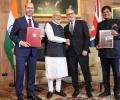
'That way you're not hostage just to US sort of exports to India.'

In its comment on the industry department's discussion paper on foreign direct investment in multi-brand retail, the joint venture between Bharti Enterprises and Walmart, said though 100 per cent FDI should be allowed in the sector, it would endorse a calibrated opening.

From the Sensex firms, Bajaj Finance, Infosys, Hindustan Unilever, ICICI Bank, HCL Tech, UltraTech Cement, Bajaj Finserv, State Bank of India, Tata Consultancy Services, Reliance Industries, Axis Bank and Larsen & Toubro were among the major gainers. However, Trent, Tata Steel, Tech Mahindra and Maruti were among the laggards.

Sections in the US State Department and Pentagon have always felt more comfortable dealing with all powerful Pakistani generals instead of elected civilians, points out Rana Banerji, who headed the Pakistan desk at RA&W.

Sanctioning Russian oil would have led to a sharp surge in oil prices to above $80 per barrel levels, which would impact pump prices in the US ahead of midterm elections next year.

Under the amended treaty with Mauritius, for two years beginning April 1, 2017, capital gains tax will be imposed at 50 per cent of the prevailing domestic rate.
This is the largest foreign direct investment proposal in the state and represents a five-fold increase from an earlier announcement by GFH for a $2 billion to $2.5 billion investment in an "energy city".

The USIBC -- a body that represents the views of Corporate America -- hailed India's steady progress in advancing major economic reforms in a statement following Cabinet approval for opening up India's vast multi-brand retail sector to foreign direct investment and removing the FDI cap in single-brand retail.

Reflecting subdued global economic growth, India's outward foreign direct investment (FDI) fell by 33.3 per cent sequentially to $1.21 billion in August, compared to over $1.82 billion in July.

The drop was the result of the change in FDI rules, which was amplified by the border standoff between India and China.

The interplay between domestic and foreign capital will shape India's equity markets.

Weeks before the Pahalgam attack, Munir said Pakistan will not forget the issue of Kashmir, asserting, "It was our jugular vein." His comments were trashed by India.

A deep dive into Trump's new policy and what it means for Indian professionals and companies.

The crisis may not be as visible this time, but the stakes are just as high, points out Rajeswari Sengupta.

The document consolidating all the aspects of foreign direct investment policy and framework will be released by commerce and industry minister Anand Sharma, an official said.
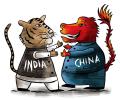
India and China have announced a series of measures aimed at improving their relationship, including maintaining peace along the border, reopening border trade, and resuming direct flights.
India's outward foreign direct investment (OFDI) nearly halved to $3.39 billion in April on an annual basis, as per data released by the RBI on Monday. The OFDI stood at $6.71 billion in April 2021. On sequential basis too, the outward investment from India in April was lower compared to $3.44 billion in March 2022.

The Confederation of All India Traders (CAIT) representing 70 million traders has written to Union Commerce Minister Piyush Goyal, drawing his attention to the alleged violations of laws and regulations by quick commerce (qcom) companies.
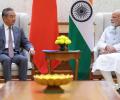
Former Army chief Gen M M Naravane (retd) said India-China ties are "on the mend" with initiatives announced at political, diplomatic and military levels. He expressed hope that China will reciprocate India's goodwill as they move forward in discussing the boundary question.
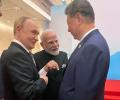
'One Chinese interlocutor said India should realise that "China can do without India, but India could not do without China", pointing to its inability to do without Chinese intermediates and components,' former foreign secretary Shyam Saran discovers on a visit to China.

The income-tax (I-T) department has issued showcause notices under Section 68 of the Income-Tax Act to several startups over funds routed through Singapore, seeking explanations for investments received over the past five years, people familiar with the development said. The department is questioning the source, identity, and creditworthiness of overseas investors in these transactions, they said.

'Right now, silver -- and especially platinum -- are very cheap compared to gold. If I were buying today, I would choose platinum.'

Trade links with Israel have strengthened in the past few years, even as the value of goods exchanged with Iran has diminished. Iran accounted for $3.9 billion worth of India's exports in the four quarters ending December 2019, compared to $3.6 billion to Israel. However, India's exports to Iran dropped to $1.2 billion as of December 2023, on a rolling four-quarter basis, while exports to Israel grew to $6.1 billion in the same period.
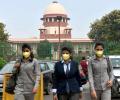
Shedding its opposition, the Bar Council of India (BCI) on Wednesday took a significant decision to permit foreign lawyers and law firms to practise in areas such as foreign law, international legal issues and arbitration matters, saying that the legal fraternity here may be left behind if it sleeps over the matter.
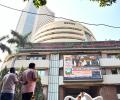
'BSE has facilitated nearly Rs 35 trillion in capital raising across multiple segments.'
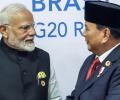
India is trying hard to erase Indonesia's wariness about New Delhi, building security cooperation in the Indian Ocean and Pacific Ocean. If Indonesia decides to buy the Brahmos missile, it would further strengthen relations between the world's most populous nation and the most populous Islamic country.
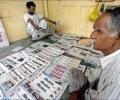
The Delhi high court on Tuesday dismissed a PIL seeking to make Indian citizenship a pre-requisite for a person to be appointed as the editor of a publication.

Fast-moving consumer goods (FMCG) distributors' association has written to the Ministry of Commerce and Industry, expressing its apprehensions that the "unchecked expansion" of quick commerce platforms was leading to severe disruptions in the retail ecosystem. India Consumer Products Distributors Federation on Thursday shot an email to the government, saying that significant challenges were posed by the rapid growth of quick commerce platforms such as Blinkit, Zepto and Instamart to the traditional retail sector and the FMCG distribution network in the country.

Ducati would like to develop a motorbike racetrack on the lines of the Buddh International Circuit.
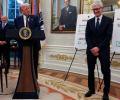
'India has intentionally taken advantage of the war in Ukraine to dramatically increase its purchases of Russian crude, when there are roughly 40 major crude providers that could satisfy Indian demand.'
